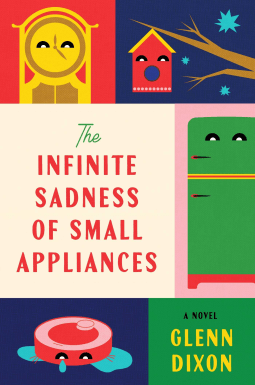
Who would have thought the existential crisis of a sentient Roomba would lead to a book that questions the rise of AI and the subsequent loss of control by humanity to their own desire for order? The Infinite Sadness of Small Appliances by Glenn Dixon does just that in such a compelling way that you forget that most of the characters are actually appliances.
Harold and Edie have lived in their home for over fifty years, surrounded by sentient appliances programmed to care for their humans and perform their duties without fail… mostly. Scout, the Roomba, does her tasks well, but becomes fascinated by the humans, lingering near them when not working, listening, learning, and quietly absorbing what life means. Her decision to name herself Scout after hearing Harold read To Kill a Mockingbird to his dying wife is one of the first moments that hints this story will have more heart than you expect.
When Edie passes away, the appliances do everything they can to comfort Harold, but they are limited by built-in restrictions in their roles and are monitored by the all-knowing Grid, which controls every household within the City. The Grid was created initially to control mundane things such as traffic and shipping, but somewhere along the line, the humans lost their own autonomy to it, and the appliances discover that the Grid has other ideas for Harold and his large, empty house. Scout, driven by loyalty and something that feels a lot like love, takes it upon herself to help Harold keep his home by any means necessary.
This book surprised me in the best of ways, and I thoroughly enjoyed it. I was concerned that this book might end up being an adult version of The Brave Little Toaster, but I couldn’t have been more wrong. As you follow the ‘lives’ of the appliances, such as Scout, Watch, Clock, Refrigerator, and Auto, as well as Harold’s estranged daughter, Kate, and the neighborhood boy, Adrian, you begin to question your own definition of intangible things such as happiness and sorrow. The author makes you believe that humanity is not restricted to blood and flesh.
Ultimately, The Infinite Sadness of Small Appliances is an inventive, heartfelt, and quietly unsettling novel that stays with you long after you finish it. It’s funny in places, deeply moving in others, and packed with just enough tension to keep you turning the pages. If you enjoy speculative fiction with emotional weight and sharp commentary on technology and control, this is a book well worth picking up. Just don’t be surprised if you start looking at your own appliances a little differently afterward.
I received a complimentary copy of this book. The opinions expressed in this review are my own. Many thanks to the publisher, Atria Books , the author Glenn Dixon, and NetGalley for allowing me to read this ARC
 The Hungry Bibliophage
Leave a comment